Our use of Open Atrium
One of the main problematic that arises during a project is “How can we keep track of all the information from the start until the end”. Who never had an inbox full of threads, a succession of email containing changes in a document that is referring to another thread of mails, or have to dig in the mailbox to find all the necessary documents for a newcomer.
The solution to this issue, and many more, is a collaboration tool. We tried different solutions like, for example, Redmine, which ended up being too technical to be used as a true project management tool (we however kept it as an internal tool for tickets tracking on some projects). We developed our own Drupal based platform at some point; Ren. We finally sticked to Open Atrium from the Development Seed folks. The basic built-in features (Blog, Case tracker, Notebook, Calendar, Shoutbox and Dashboard) allow us to have a single place to store all of our documentations and keep discussions organized.
As we started to use it, it was clear that its feature set could go beyond straight project management. As of now we use it;
- As a project management tool, by creating a group per project and communicating with the customer only via the platform. This ensures that no information is lost and is available at anytime to anyone who is part of the project (thus the group). This is where we also share the project estimate, discuss the features and provide updates to the customer.
- As an internal communication tool, by creating a common pool of documentation on processes, keeping track of holidays, get reminder for employees birthdays or discussing projects ideas with our employees. We actually go down to the most common tasks are buying new pencils or filling in the fridge (developers tend to have a high consumption of sweet drinks…).
- As an administrative tool, which access is limited to the management team, were we share sensitive information and coordinate marketing campaigns. As our management can have period of intensive trips (Ronan just came back after a 4 months business trip around the world: USA, Sudan, France, Denmark…), it is useful to have all the information related to the company accessible from anywhere at anytime.
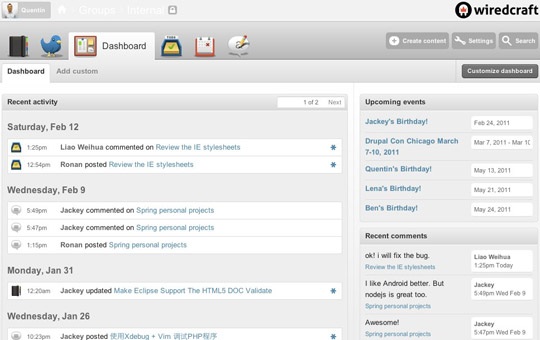
Open Atrium ended up being a collaboration tool more than anything else and we use it in all steps of our project as well as our internal discussion. Its flow is indeed very much in synch with our Agile methodology, letting us work asynchronously: another important factor for projects with teams scattered around the world. This was key to the success of projects such as the one we led on the Southern Sudan Referendum’s voting infrastructure were the team was divided between our office in Shanghai and Juba, Sudan.
On top of this, we use a range of SaaS such as Google Apps, Github; we’ll probably get into the details of that setup in a future post.
Using such a tool on our project work usually requires us to the take time of educating our clients, but that investment ends up being invariably a huge gain on both sides of the table; it provides a very high transparency of our internal processes to the customer and let him get involved graciously with our team.
In a nutshell, Open Atrium is an awesome Swiss army knife; we’d recommend you to give it a try and can’t remember the number of clients we got switch over to using it as their own intranet.
Stay tuned
Follow our newsletter or our WeChat account; every other week you'll receive news about what we're up to, our events and our insights on digital products, omnichannel, cross-border ecommerce or whatever the team fancies.
-
Add us on WeChat
-
Subscribe to our newsletter